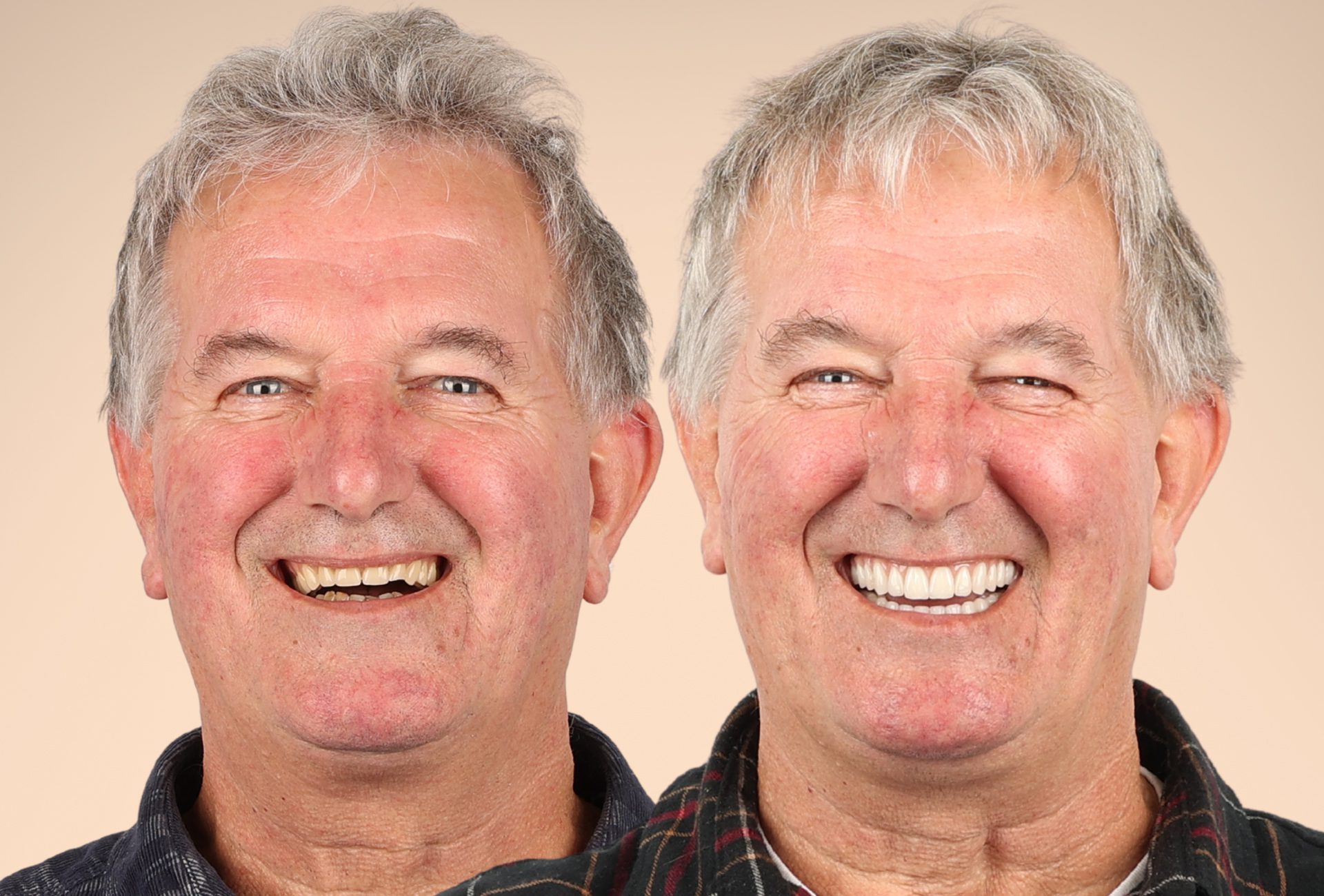
Here’s something a lot of people don’t realise: full mouth dental implants aren’t a one-size-fits-all treatment, and the materials used to build your final teeth are just as important a decision as the implants themselves.
If you’ve been researching zirconia dental implants in Ballarat, you’ve probably come across terms like “metal-free,” “monolithic zirconia” and “biocompatible materials” and wondered how they actually apply to your own situation. This guide breaks it down in plain English, so you understand your options before you consult with our Ballarat team.
What full mouth dental implants are actually made of
Full mouth dental implants, sometimes referred to under systems like All-on-4®, involve two separate parts working together:
- The implants themselves — titanium fixtures placed within the jawbone, which act as the anchor points for your new teeth.
- The final bridge (prosthesis) — the visible set of teeth attached to those implants, which can be made from a range of different materials.
At Fixed Teeth Australia Ballarat, this is where zirconia comes into the conversation. While the implant fixtures themselves are almost universally titanium (a material with a long, well-documented history in implant dentistry), the material used for the bridge on top is where patients have genuine choice, and where zirconia has become an increasingly common option.
What is zirconia, and why does it matter?
Zirconia is a ceramic material that has been used in dentistry for a number of years, including in crowns, bridges and some full arch prostheses. It’s known for its strength and its tooth-like appearance, which is part of why it’s become a talking point for patients exploring full mouth dental implants.
For suitable patients, a zirconia bridge can be designed and milled as a single, solid structure, sometimes described as “monolithic zirconia.” This differs from some other bridge materials, which may combine an internal metal framework with an acrylic or composite outer layer.
It’s worth being clear here: material choice is a clinical decision, not a marketing decision. Whether zirconia, a titanium-reinforced acrylic bridge, or another material is the right option for you depends on factors including your bite, the number of implants placed, your bone structure, and your individual treatment plan. This can only be properly assessed by your treating dentist following a clinical examination.
Metal-free prosthetics: what this means in practice
Some patients are specifically interested in “metal-free” prosthetic options, often because of a preference to avoid metal in the visible bridge structure, or because of a known sensitivity to certain metals.
A metal-free zirconia bridge means the final visible prosthesis doesn’t rely on an internal metal substructure. This is different to saying the entire treatment is metal-free, since the implant fixtures anchoring the bridge into the jaw are still typically made from titanium, which remains one of the most extensively studied and widely used materials in implant dentistry.
If avoiding metal is a priority for you, this is exactly the kind of question worth raising directly at your consultation. Our Ballarat team can talk through:
- Which parts of your treatment would involve metal, and which wouldn’t
- Whether a zirconia bridge may be a suitable option based on your individual case
- What alternatives exist if zirconia isn’t considered appropriate for your particular bite or jaw structure
Biocompatible material choices
“Biocompatible” is a term you’ll come across a lot when researching dental materials. In general terms, it describes materials that are designed to be compatible with the human body, meaning they’re intended not to trigger an adverse biological response when used in dental or medical applications.
Both titanium and zirconia are materials with established histories of biocompatibility in dentistry. That said, biocompatibility is a general material property, not a guarantee for every individual. Some patients have specific sensitivities or medical histories that need to be discussed with your dentist as part of a proper clinical assessment, rather than assumed based on general material information found online.
If you have a known metal allergy, a specific medical condition, or previous reactions to dental materials, it’s important to raise this directly with our Ballarat team so it can be factored into your treatment planning from the outset.
Zirconia within the All-on-4 style approach
Full arch treatment protocols, often grouped under the umbrella of All-on-4® style systems, are generally built around the same core stages regardless of which final bridge material is chosen:
- Consultation and planning — assessing your suitability, bone structure and treatment goals.
- Surgery — placement of implant fixtures, for suitable patients completed under general anaesthetic in a purpose-built operating environment.
- Initial (“test drive”) teeth — a first set of fixed teeth fitted while healing takes place, following our structured two bridge process.
- Final bridge design and fitting — where your material choice, including zirconia, comes into play, individually designed and crafted in-house.
- Long-term maintenance — ongoing reviews and care, because implant-supported teeth are not a “set and forget” treatment, regardless of the material used.
At Fixed Teeth Australia Ballarat, full mouth dental implants are all we do, all day every day. That focus means our team, including Dr Brian Johnston and Dr Jonathan Marin, works through this exact process with patients on a daily basis, and our in-house laboratory team designs, crafts and adjusts bridges, including zirconia options, right here in Australia.
Weighing up your material options
There’s no single “best” material for every patient, and any content suggesting otherwise should be treated with a healthy dose of scepticism. What’s genuinely true is that different materials come with different clinical considerations, including:
- Strength and wear characteristics over the life of the prosthesis
- Aesthetics, including how light passes through the material and how closely it can be matched to a natural tooth appearance
- Weight and feel, which can vary between materials
- Maintenance and repair considerations, since different materials are adjusted and repaired differently if damage occurs
- Cost, since material choice can affect the overall treatment investment
These are exactly the kind of trade-offs your treating dentist should walk you through individually, rather than a generic list applying equally to everyone.
Common questions about zirconia and metal-free options
Is zirconia better than other bridge materials? There’s no single material that’s automatically “better” for every patient. Zirconia suits some clinical situations well, while other materials may be more appropriate in others. This is determined case by case, following a clinical assessment.
Does choosing zirconia mean no metal is used at all? Not necessarily. A zirconia bridge can be designed without an internal metal substructure, but the implant fixtures themselves, which anchor the bridge into the jawbone, are typically titanium. If a fully metal-free approach is important to you, raise this directly with our team.
Is zirconia guaranteed to last longer than other materials? No material comes with a guarantee. Like any dental prosthesis, zirconia bridges require regular maintenance, cleaning and reviews, and individual outcomes vary between patients.
Can everyone have a zirconia bridge? Not necessarily. Suitability depends on individual factors such as bite, bone structure, the number and position of implants, and your overall treatment plan. This can only be properly assessed following a clinical examination with our Ballarat team.
Is zirconia more expensive than other options? Material choice can affect the overall cost of treatment. Our Ballarat team is built around transparent pricing with no hidden extras, so any material-related costs will be discussed clearly with you before you make a decision.
Why discuss this with a dedicated implant clinic
Material questions like these are exactly why many patients choose a dedicated full mouth dental implant clinic rather than a general dental practice. At Fixed Teeth Australia Ballarat, our flagship clinic servicing Western Victoria, the team works through material selection, treatment planning, surgery and long-term maintenance as a coordinated, structured process, all under one roof.
Because everything from your consultation through to your final bridge design is handled by the same team, questions about zirconia, metal-free options and biocompatible materials can be answered in the context of your actual treatment plan, rather than as a general or hypothetical discussion.
Book a consultation with our Ballarat team
If you’d like to understand whether a zirconia bridge, a metal-free prosthetic option, or another material choice may be suitable for your individual case, book a consultation with our Ballarat team and we’ll walk you through what to expect.
No jargon. Just straight answers in plain English.
Fixed Teeth Australia Ballarat 212 Drummond St N, Ballarat Central VIC 3350 (03) 5364 9500
*Clinical evidence reference: Malo P, de Araújo Nobre M, Lopes A, Moss SM, Molina GJ. A longitudinal study of the survival of All-on-4® implants in the mandible with up to 10 years of follow-up. J Am Dent Assoc. 2011;142(3):310–320.
Published long-term clinical research relating to full arch dental implant treatment has reported implant retention rates of approximately 98% in the mandible over a 10-year period. Individual treatment outcomes vary. Suitability for treatment, including material selection, can only be determined following a clinical assessment.
Any surgical or invasive procedure carries risks. Before proceeding, you should seek a second opinion from an appropriately qualified health practitioner.
This content is provided for general information only and does not constitute medical or dental advice. Material suitability and treatment outcomes vary between individuals. A personalised assessment with a qualified dental practitioner is required to determine what treatment, and which materials, if any, may be suitable for you.